


SO2 Preserved Mushrooms: Residue Limits & De-Sulfiting
Jul 27, 2026
SO2 Preserved Mushrooms: Residue Limits and De-sulfiting Techniques

Sulfur dioxide (SO2) treatment prevents enzymatic browning and microbial spoilage in raw Agaricus bisporus, enabling stable ambient bulk transport in 50kg plastic drums. Downstream food processors and commercial canneries must apply controlled thermal and washing protocols to reduce raw storage sulfites (typically 800–1,000 ppm) down to finished product thresholds (< 10–50 ppm) mandated by destination market regulations.
Mechanism of SO2 Preservation in Bulk Vegetables
During post-harvest handling, polyphenol oxidase (PPO) enzymes interact with oxygen to oxidize phenolic compounds, producing brown pigments (melanins) that degrade mushroom tissue. Introducing sodium metabisulfite (Na2S2O5) or sodium bisulfite (NaHSO3) into the steeping liquid generates free sulfur dioxide gas and bisulfite ions (HSO-3).

This chemical reaction halts discoloration through two primary pathways:
Enzyme Inactivation: Bisulfite ions reduce quinones back to colorless diphenols and bind irreversibly to active sites on the PPO enzyme structure.
Microbial Inhibition: Un-ionized $SO_2$ penetrates cell walls of wild yeasts, molds, and aerobic bacteria, disrupting respiratory enzymes and protein disulfide bonds.
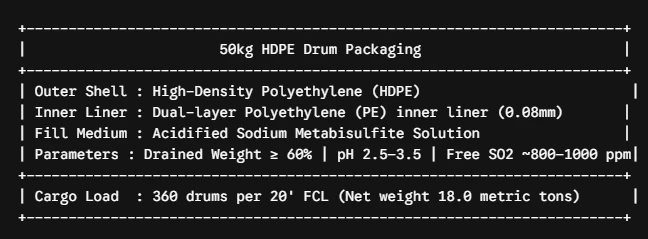
For downstream re-processors sourcing wholesale mushroom in SO2 bulk, maintaining a constant SO2 concentration above 800 ppm during ocean transit guarantees structural firmness and zero oxidation prior to final thermal processing.


De-Sulfiting Protocols for Downstream Processing
Downstream commercial canneries and ready-meal manufacturers cannot package mushrooms with raw-tier SO2 concentrations. Industrial de-sulfiting relies on three sequential physical and chemical stages to drive off sulfur dioxide gas and leach bound sulfites out of the mushroom vascular tissue.
| Processing Stage | Technical Parameters | SO2 Reduction Efficiency | Yield & Quality Impact |
| Stage 1: Ambient Leaching | Static immersion in running potable water (15–20℃) for 4–6 hours; water refresh cycle every 60 minutes. | 40% – 50% initial loss | Restores tissue turgidity; minimal loss of soluble solids. |
| Stage 2: Thermal Blanching | Continuous steam or hot water blanching at 88–95℃ for 6–10 minutes under low vacuum or open ventilation. | 35% – 45% additional loss | Drives thermal gas expulsion; stabilizes tissue shrinkage (3–5%). |
| Stage 3: Retort Sterilization | High-pressure thermal processing in final containers at 121.1℃(F0 ≥6.0) with hydrogen peroxide or citric acid acidulant. | Remaining trace breakdown | Converts free SO2 to fixed sulfate (SO_4^{2-}) below detection limits. |
Operational Steps for Factory QA
Operational Steps for Factory QA:
Hydration & Agitation: Place drained mushrooms into stainless steel tanks with forced air agitation. Maintain a 1:4 mushroom-to-water ratio.
pH Adjustment: Lowering the wash water pH to 2.0–2.5 accelerates the equilibrium shift toward volatile, gaseous SO2, which escapes via exhaust hoods.
Hot Water Extraction: Pass the leached mushrooms through a rotary blancher at 92℃. Volatile SO2 vaporizes rapidly at temperatures exceeding 80℃.
Quality Assurance Note: Over-washing during Stage 1 can degrade the natural umami flavor profile (monosodium glutamate equivalent) and reduce drained yield below 58%. Monitor total dissolved solids (TDS) via refractometer to optimize wash duration.
Frequently Asked Questions
What is the Minimum Order Quantity (MOQ) for bulk SO2 preserved mushrooms?
+
-
The standard minimum order quantity is one 20-foot full container load (20' FCL), containing 360 heavy-duty 50kg plastic drums (net weight 18.0 metric tons). Mixed-item container loads featuring diced, sliced, or whole button sizes under identical brine specifications are available upon request.
What is the shelf life and storage requirement for drummed SO2 preserved mushrooms?
+
-
The product maintains a guaranteed shelf life of 24 months from the packing date when stored in unopened original containers at ambient temperatures (5 ℃ to 25℃). Keep containers away from direct sunlight and avoid freezing conditions to maintain cell wall structure.
What shipping documents are provided to clear customs at destination ports?
+
-
Every shipment includes a Commercial Invoice, Packing List, Clean On-Board Bill of Lading, Official Health Certificate, Phytosanitary Certificate, Certificate of Origin (Form E/FTA where applicable), and a Batch-Specific Certificate of Analysis (COA).