


Prevent Garlic Discoloration in Bulk Vinegar Preservation
Jul 22, 2026
Preventing Garlic Cloves from Discoloring in Vinegar Preservation

Discoloration in acid-preserved garlic-manifesting as intense blue or green pigmentation-is caused by an enzymatic reaction between isoalliin, alliinase, and amino acids under acidic conditions. For industrial food processing lines, preventing garlic in vinegar discoloration requires precise control of thermal blanching temperatures, acid medium formulation (pH< 3.5), and post-packaging UV shielding. This technical report details the biochemical pathways of pigment formation, industrial acid preservation standards, and warehouse storage protocols required to guarantee visual color stability in bulk pickled garlic shipments.Discoloration in acid-preserved garlic-manifesting as intense blue or green pigmentation-is caused by an enzymatic reaction between isoalliin, alliinase, and amino acids under acidic conditions. For industrial food processing lines, preventing garlic in vinegar discoloration requires precise control of thermal blanching temperatures, acid medium formulation (pH < 3.5), and post-packaging UV shielding. This technical report details the biochemical pathways of pigment formation, industrial acid preservation standards, and warehouse storage protocols required to guarantee visual color stability in bulk pickled garlic shipments.
Biochemical Mechanisms of Green/Blue Pigment Formation
When garlic tissue is damaged during mechanical peeling, alliinase converts isoalliin into reactive sulfur-containing intermediates. In an acidic environment (pH 3.8 - 5.0), these intermediates react with free amino acids (specifically glycine and lysine) to form pyrrole complexes. Polymerization of these pyrroles generates blue-green pigments (pyrrolylpyrrole compounds) that render the garlic visually unmarketable for commercial retail canning or foodservice distribution.
Enzymatic Activity: Active alliinase enzymes remaining in raw, unblanched garlic tissue accelerate pyrrole synthesis upon contact with acetic acid.
Trace Metal Ions: Concentrations of copper (Cu^2+ > 2.0 mg/kg) or iron (Fe^3+>5.0 mg/kg) in processing water act as catalysts, accelerating pigment formation.
Storage Temperature Spikes: Temperature fluctuations between 10℃ and 20 ℃ during early acid curing activate latent enzymatic pathways.

Process Controls: Thermal Inactivation and Acidity Titration
Preventing discoloration in commercial preservation relies on three synchronized processing parameters: enzyme thermal inactivation, precise acetic acid buffering, and water quality control.
| Processing Step | Control Parameter | Quality Assurance Standard | Industrial Purpose |
| Water Purification | Reverse Osmosis (RO) Filtration | Total Dissolved Solids (TDS) < 50ppm; Cu^2+ < 0.05\mg/kg | Eliminates catalytic heavy metal ions triggering pigment reactions. |
| Thermal Blanching | 85℃- 90℃ for $120 - 180 seconds | Enzyme inactivation check via guaiacol peroxidase assay | Denatures alliinase enzymes without softening clove cellular structure. |
| Acid Medium Formulation | Glacial Acetic Acid + Citric Acid Buffer | Acetic Acid Concentration: 2.5% - 3.5%; pH < 3.5 | Drives equilibrium past the active enzyme pH window (pH 3.8-5.0). |
| Sulfite Stabilization | Sodium Metabisulfite (Na2S2O5) Addition | SO2 residue < 30ppm | Inhibits non-enzymatic browning and scavenges dissolved oxygen. |
Industrial Action Item: Maintaining color stability across long ocean transit cycles requires strict adherence to physical and chemical parameters. To examine our complete product matrix, chemical tolerances, and drum packaging specifications for acid-preserved lines, inspect our verified technical documentation for garlic in vinegar discoloration.
Light Exposure Controls and Drum Packaging Requirements
After barrel filling, light exposure and dissolved oxygen accelerate oxidative browning and pigment fixation. Industrial export lines must utilize light-impermeable packaging systems and UV-shielded storage environments.
1.Step 1: HDPE Drum Inspection and Liner Placement:Barrier sealing against oxygen.
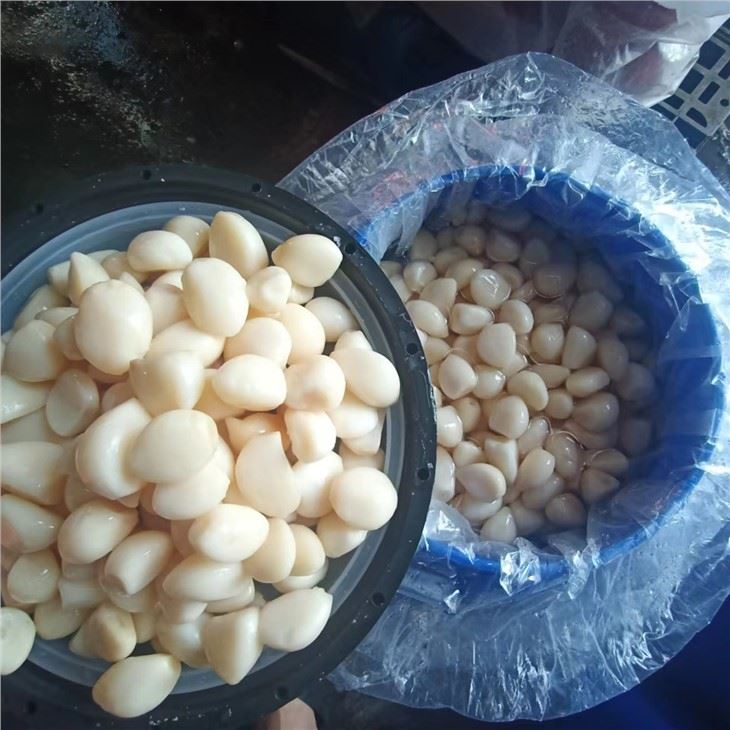
Verify clean, food-grade High-Density Polyethylene (HDPE) 50kg or 200kg drums. Insert dual-layer high-density polyethylene liners (80 um thickness per layer) to prevent acetic acid vapor transmission and oxygen ingress.
2.Step 2: Hot Acid Filling and Vacuum Purging:Headspace reduction to <2cm.
Fill drums with blanched garlic cloves and cover with 85℃ acid medium (pH 3.0 - 3.2). Maintain brine level to ensure full immersion of solids (drained weight ≥60%). Purge headspace with food-grade nitrogen gas before mechanical heat-sealing.
3.Step 3: UV Shielding and Climate Control:Warehouse temperature <25°C.
Store sealed drums in dark, UV-shielded warehouses. Avoid direct sunlight and maintain ambient storage temperatures between 5℃and 25℃ to lock in color stability prior to container loading.
Frequently Asked Questions
What is the Minimum Order Quantity (MOQ) for bulk pickled garlic in drums?
+
-
Our factory minimum order quantity is one 20-foot Full Container Load (20'FCL). A 20'FCL accommodates 360 HDPE drums (50kg gross weight / 30kg guaranteed net drained weight per drum), delivering 10.8 metric tons of drained garlic solids.
What is the guaranteed shelf life and storage requirement for vinegar-preserved garlic?
+
-
Stored in sealed, light-impermeable HDPE drums at $5^\circ\text{C}$ to $25^\circ\text{C}$ in a dry warehouse, our vinegar-preserved garlic maintains a certified shelf life of 24 months. The product meets BRC, HACCP, and ISO22000 standards.
How can QA/QC managers request a sample batch for acid stability testing?
+
-
We dispatch 1.0kg to 2.0kg pre-shipment sample jars packed in matching acid medium (pH < 3.5) via express air courier (DHL/FedEx) within 48 hours. Prospective buyers cover air courier freight fees, which are credited against initial commercial contracts.