


Brined Mushroom Salinity Standards for Industrial Soups
Jul 20, 2026
Optimal Salinity Levels for Brined Mushrooms in Canned Soup Production

Maintaining an exact mushroom in brine salinity range of 21% to 22% during bulk storage is the industrial standard for preventing microbial spoilage while optimizing downstream desalting cycles in canned soup manufacturing. For commercial canning operations, improper brine preservation alters tissue firmness, causes cell wall rupture, and degrades net drained weights during thermal retort processing. This technical briefing evaluates the biochemical mechanisms of high-salinity preservation, desalting kinetics, and processing schedules required to integrate drum-preserved mushrooms into industrial soup formulas.
Antimicrobial Preservation Mechanics: The 21-22% Salinity Standard
Industrial preservation of Agaricus bisporus in 50kg HDPE plastic drums relies on osmotic pressure to halt cellular respiration and inhibit pathogenic bacterial growth. Maintaining a saturated sodium chloride (NaCl) concentration between 21% and 22% creates a high-osmotic environment that lowers water activity (aw) below 0.75.
Microbiological and Enzymatic Inhibition
Pathogen Suppression: Spoilage organisms such as Clostridium botulinum (minimum aw = 0.93) and Listeria monocytogenes (minimum aw = 0.92) are rendered completely inactive at a 21% salinity threshold.
Enzymatic Browning Control: High salt concentration, combined with a controlled citric acid buffer (pH 3.5–4.0), inactivates polyphenol oxidase (PPO) enzymes, eliminating enzymatic browning without requiring excess sulfur dioxide (SO2 residue < 50t pPM).
Turgor Pressure Preservation: At 21–22% NaCl, fungal cell walls undergo controlled plasmolysis without structural collapsing, preserving the firm texture required for subsequent industrial slicing and retorting.
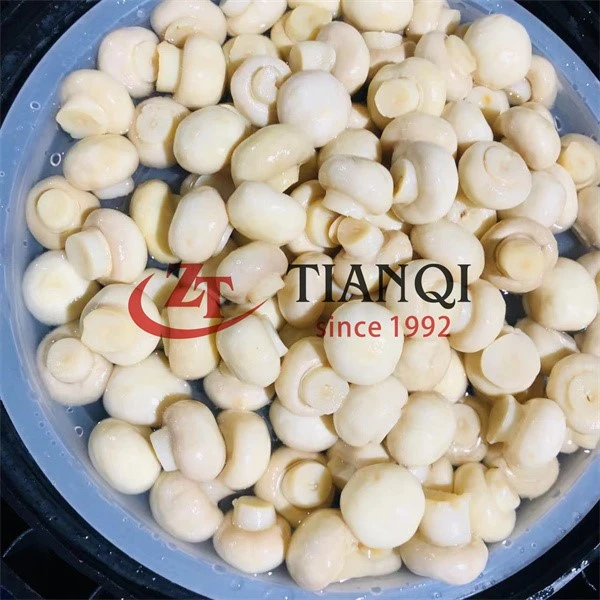
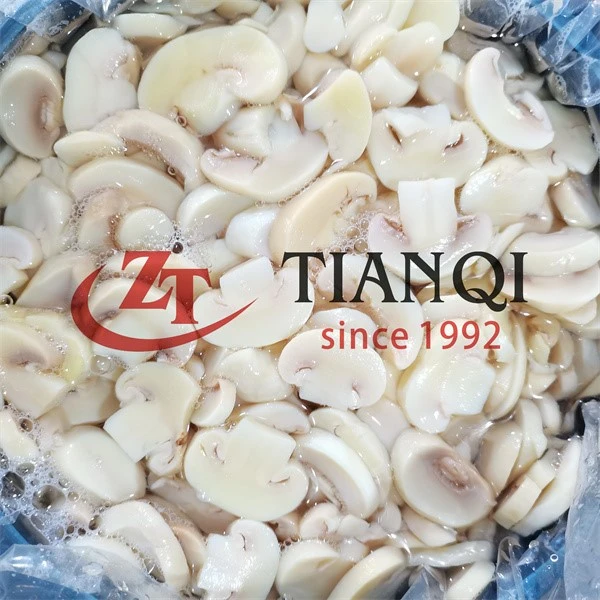
Impact of Preservation Salinity on Downstream Desalting Yields
For soup manufacturers, processing preserved mushrooms requires a desalting step to reduce salt concentrations from 21% down to ≤1.5% prior to kettle batching. The initial preservation medium directly determines total water consumption, osmotic equilibrium rates, and final drained weight retention.
| Technical Parameter | Standard Brine (21-22% NaCl) | Low-Salt Acidified Brine (8-10% NaCl) | Impact on Industrial Canning Operations |
| Microbial Stability (Unrefrigerated) | 24 Months (aw < 0.75) | 6 Months (aw approx 0.88) | High-salinity allows ambient warehouse storage (5°C - 25°C). |
| Drained Weight (D.W.) Stability | Guaranteed ≥ 60% | Variable (52% - 56%) | High-salinity prevents cell leaching, maintaining 30kg solids per 50kg drum. |
| Desalting Water Factor | 3.5L per1 kg solids | 1.8L per 1 kg solids | Counter-current washing systems rebalance overall water utility expenditures. |
| Texture Retention Post-Retort | High (crunch preserved) | Moderate (softened tissue) | High-salinity withstands 121°C retort sterilization F0 ≥ 6). |
Industrial Action Item: Purchasing raw materials with fluctuating salinity levels causes batch-to-batch sodium variance in final soup formulations. To review our factory's physical and chemical quality control standards for 2026 crop drum packaging, inspect our verified mushroom in brine salinity specifications.
Industrial Desalting Schedules for Canned Soup Facilities
To integrate drum-preserved mushrooms into high-speed canning lines, quality assurance teams utilize continuous counter-current washing tanks or batch-soaking agitated vessels to wash out NaCl.
1.Phase 1: Initial Surface Flume Flush:Agitated cold water wash (15-20 min).
Drained mushrooms drop into a continuous flume system with cold running water (10°C - 15°C). This mechanical agitation removes surface brine and reduces internal salinity from 22% to approximately 10–12%.
2.Phase 2: Osmotic Equilibrium Soaking:2 to 3 water batch exchanges (2 to 3 hours).
Mushrooms are transferred to agitated soak tanks filled with potable water at a 1:4 product-to-water weight ratio. Water is replaced every 60 minutes. Internal salinity drops exponentially:
Salinity Target≤1.5%after 180 minutes
3.Phase 3: QA Verification & Slicing:Dewatering screen & inline refractometer check.
Desalted mushrooms pass over a vibrating mesh dewatering screen. A QC technician checks slice samples via digital refractometer or silver nitrate titration (AgNO3). Once verified at ≤1.5% NaCl, the product moves directly to automated industrial dice/slice machines for kettle addition.
Physical and Chemical TDS Parameters for Canned Soup Grade
Cap Diameter Grading: Whole (15–25mm, 25–35mm, 35–50mm) or Sliced (thickness 4–6mm).
Heavy Metal Tolerances: Lead (≤0.1mg/kg), Cadmium (≤0.05mg/kg), Arsenic (≤0.1 mg/kg) per ICP-MS testing under ISO 17025.
Pesticide Residues: Compliance with EU Regulation (EC) No 396/2005 and US FDA MRL standards.
Microbiological Standards: Commercially sterile post-desalting and retorting; Aerobic Plate Count < 1,000CFU/g pre-cook.
Frequently Asked Questions
What is the Minimum Order Quantity (MOQ) for bulk brined mushrooms?
+
-
Our factory minimum order quantity is one 20-foot Full Container Load (20'FCL). A 20'FCL contains 360 food-grade HDPE plastic drums (50kg gross / 30kg net drained weight per drum), delivering a total net drained weight of 10,800 kg of mushroom solids.
What is the certified shelf life of 21-22% brined mushrooms?
+
-
Stored in sealed HDPE drums at ambient temperatures between 5°C and 25°C, our brined mushrooms maintain a certified shelf life of 24 months. The high salinity prevents bacterial growth and tissue degradation over long storage cycles.
How do I request a free sample batch for laboratory testing?
+
-
We supply 1.0kg to 2.0kg pre-shipment sample jars packed in matching 21-22% brine for QA/QC testing. Samples are dispatched via DHL/FedEx within 48 hours of request. Buyers cover international express air courier charges.